
Sustainability
We care for your IML.
IML labelling: green by definition
During the IML labelling process, the inseparable union between label and injected plastic part occurs, and as a rule, the IML label is printed on a film composed of the same polymer as the injection material.
This is the foundation of the sustainability of this labelling system. The fact that an IML-labelled plastic part is single-component means that an IML-labelled container can be recycled without any problem. Other labelling systems are much more problematic because they require the consumer to remove the label, which is not always done. The IML-labelled container, on the other hand, is normally single-component and does not require any action by the consumer before disposal other than roughly emptying any leftover contents. The presence of printing ink is tolerated for mechanical downcycling and is not a problem for chemical recycling or for some new deep-wash technology.
Today the imperative is to be monomaterial.
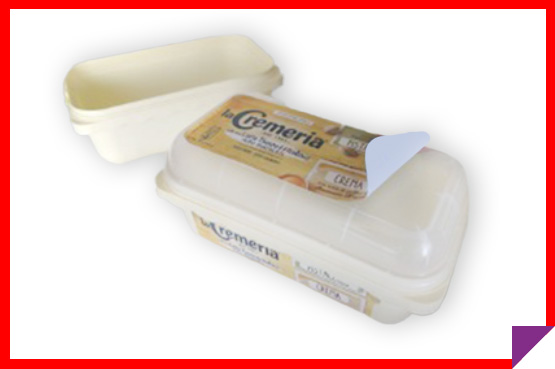
Removable IML label - Giving the container a second life
It all started from the fact that one of our customers had a mould to produce a 1-litre ice cream container that was a bit oversized for the times, but certainly robust. They therefore looked for a way to enhance it, exploiting this second characteristic. The idea was to give the container a second life after consumption of the product.
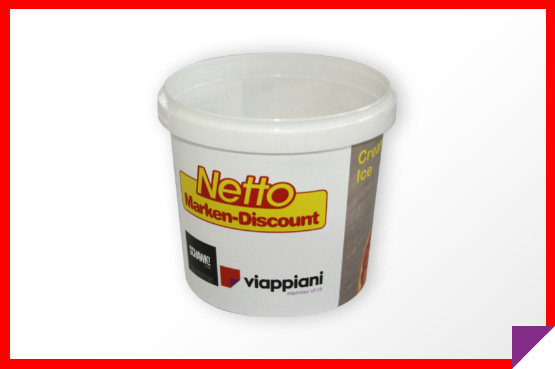
Thanks to a special removable IML label, the consumer can transform the packaging into a durable fridge container like those that can be purchased in a household goods store. We have thus given the product a second life without producing a new piece, without even going through recycling, composting or other processes that, although virtuous, still consume some energy.
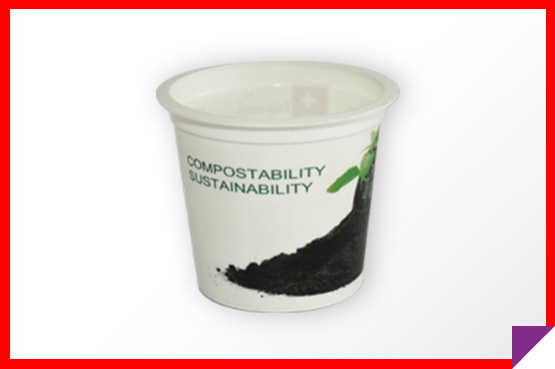
PLA IML label - The virtuous circle of composting
Compostable materials are fully part of the solutions for a sustainable future. Viappiani has also developed an industrially compostable IML label based on polylactic acid (PLA) for containers injected in compostable bioplastic.
This development was presented as early as 2018 at the NPE trade fair in Orlando, USA, in the form of a Keurig-format coffee capsule labelled IML. Coffee capsules are the ideal product for this technology because the packaging used contains the exhausted product which is also compostable. The IML label allows the product to be branded with total respect for the environment, giving life to the virtuous cycle of composting.
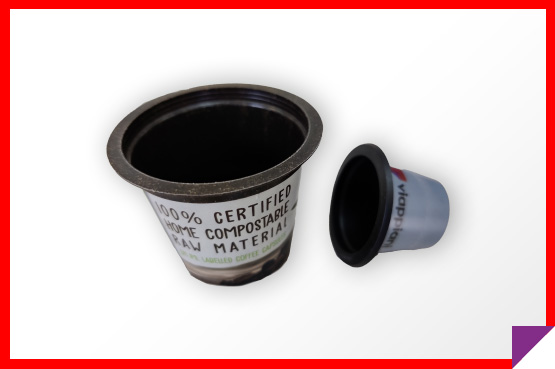
Home compostable IML label - Cellulose for another level of composting
In light of some limitations of industrial composting, it has also become necessary to develop IML labels for domestically compostable materials. The reference application is always that of coffee capsules. In this case it was not possible to create a label on compostable bioplastic, but we created a cellulose label that can be composted with the container even though it is not monomaterial.
This, which we believe to be an important step forward towards a sustainable future, is a development that is being completed. Various tests have given positive results across the entire line and on the next occasion we also expect industrial production.
Separable IML label
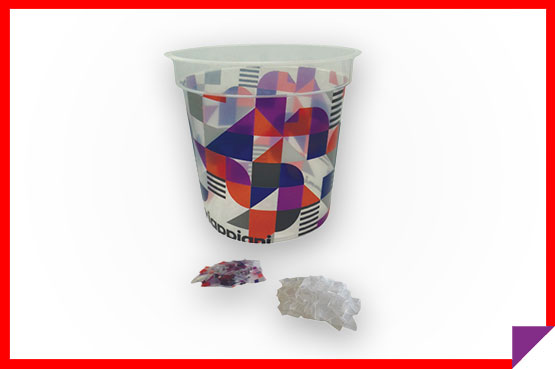
During the fragmentation phase in the recycling process, a label of this type separates from the injection material and can be removed through a process called elutriation. Thanks to the use of a separable IML label, it is possible to obtain white or natural rPP instead of grey rPP. In this way the plastic can be recycled rather than downgraded (downcycling), maintaining its value and expanding its reuse possibilities. These labels are available in both white and transparent versions.
IML labels with digital watermarks - The breakthrough for new recycling targets
Digital watermarks, specifically Digimarc codes, are invisible codes inserted into the label printing files to be read by a camera in a plastic waste sorting plant.
With this technology, IML labels become smart and convey a large amount of information for different purposes. The first is the optimisation of recycling rates with recognition rates higher than NIR technology. This is what the HolyGrail 2.0 initiative, of which Viappiani is a member, is working on. The project status envisages industrial tests.